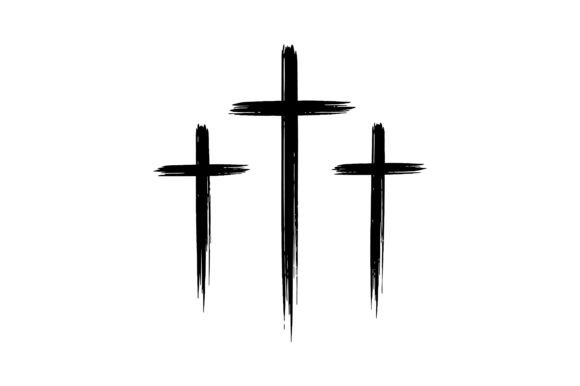
Three Grunge Crosses Silhouette Design
A Designer’s First Look: Raw, Reverent, and Ready for Real Fabric
When I opened Three Grunge Crosses Silhouette Design, I didn’t see just another religious motif—I saw texture, intention, and quiet tension. The crosses aren’t polished or symmetrical; they’re slightly uneven, with softened edges and intentional irregularity in line weight. That grunge treatment isn’t lazy—it’s deliberate visual language. It leans into authenticity over perfection, which makes it feel handmade before a single stitch is laid down. This isn’t a design that shouts. It whispers reverence through restraint—and that’s exactly why it works so well for thoughtful, small-batch embroidery projects.
Where It Lives Best: Tote Bags, Sweatshirts, and Quiet Gifts
Last week, I used Three Grunge Crosses Silhouette Design on a heavyweight organic cotton tote for a local boutique’s “Faith & Craft” collection. The result? A piece that felt grounded—not preachy, not trendy, but deeply human. That same energy translates cleanly to sweatshirt embroidery, where the grunge texture plays beautifully against looped fleece. It also holds up surprisingly well on baby onesies (using soft fill stitch and minimal density) and linen tea towels, where the silhouette reads clearly even at 3.5 inches wide. As a T-Shirt Designs asset, it avoids looking flat or screen-printed—its subtle variation in stitch direction gives it dimensionality that digital prints can’t replicate.
What It Does for Your Brand—and What It Doesn’t
This design quietly elevates handmade presentation. When stitched on an apron for a church bake sale or as a patch on a denim jacket for a youth group fundraiser, it signals care—not just in execution, but in curation. Customers notice that difference. They trust a product that feels considered, not copied. But let’s be real: Three Grunge Crosses Silhouette Design won’t carry your entire brand identity. It’s a strong supporting player—not a logo, not a full monogram suite. Use it where subtlety adds meaning: holiday embroidery on a wool blanket, wedding gift pillow covers, or personalized gifts for someone who values quiet faith over flash.
Fabric & Hoop Realities: Where to Proceed With Care
- Stretchy fabric? Proceed only with cutaway stabilizer and basting stitches—those silhouettes lose definition fast if the ground shifts mid-stitch.
- Thin or lightweight fabric? Avoid unless you reduce stitch density manually. Fill areas can pucker or show thread shadows on voile or rayon challis.
- Dark fabric? Test contrast carefully. Some grunge treatments rely on tonal variation that disappears on black or navy without a white underlay—or a slight color shift in thread.
- Caps and curved surfaces? Not ideal. The horizontal layout and subtle asymmetry make registration trickier on rounded crowns. Stick to flat panels: front chest, back yoke, or pocket placement.
- Small hoop sizes (under 4x4")? Possible—but inspect corner details closely. The most delicate cross ends may simplify or blur if scaled too far down.
Stitch Behavior You’ll Actually See on Your Machine
In practice, Three Grunge Crosses Silhouette Design relies heavily on controlled fill stitch with strategic running stitch accents—no dense satin borders or tiny lettering to snag. That means fewer thread breaks, smoother transitions across fabric types, and forgiving performance on mid-range home embroidery machines. I ran it on both polyester twill and brushed cotton, and the grunge effect held up: slightly broken lines, soft gradients in density, no harsh edges. That’s a win for craft business owners who don’t have time to re-hoop for every minor tension tweak.
Design Assets That Earn Their Place in Your Library
As a digital embroidery file, Three Grunge Crosses Silhouette Design earns its spot not because it’s flashy—but because it solves real problems. It fits seamlessly into printable mockups for Etsy listings (especially when styled on neutral apparel), reads well in black-and-white product photos, and pairs effortlessly with minimalist fonts or earth-toned packaging. For Etsy sellers and small shop owners, it’s low-risk, high-resonance inventory: one design, multiple applications, consistent emotional tone.
Practical Designer Notes Before You Stitch
- Always test Three Grunge Crosses Silhouette Design on scrap fabric matching your final project’s weight and stretch.
- Check thread color contrast on both light and dark backgrounds—even subtle grunge needs legibility.
- Review stitch density in the thickest fill zones. If it feels heavy for your fabric, reduce by 10–15%.
- Confirm hoop size compatibility before digitizing for commercial embroidery—some versions may require 5x7" minimum.
- Inspect small interior corners and negative space: does the grunge treatment leave clean cutouts, or does it risk stitching over itself?
- Use proper stabilizer—tear-away for stable wovens, cutaway for knits or textured weaves like terry cloth.
- Verify licensing terms before selling finished products or bundling this as part of a larger design asset pack.
Final Thought: It’s Not About the Cross—It’s About the Context
What makes Three Grunge Crosses Silhouette Design valuable isn’t its theme—it’s how thoughtfully it occupies space. In a market flooded with generic religious motifs, this design respects the viewer’s intelligence and the maker’s time. It doesn’t demand attention; it invites reflection. Whether you’re stitching a custom embroidered patch for a grief support group, personalizing a kitchen towel for a new parent, or building cohesive merchandise for a faith-based small shop, this design delivers quiet confidence—not noise. And in embroidery, where every stitch carries weight, that kind of intention is rare. Keep it. Use it. Trust it.